
ASEAN Civil Society Forms Critical Axis for Green Transition, Responding to Growing Climate Threats

Amid extreme vulnerability to climate impacts and lagging progress in the energy transition, civil society organizations across Southeast Asia united at the ASEAN for the Peoples Conference (AFPC) to advocate for accelerating a just green transition. The forum, titled “Ensuring Climate Security for All: What Civil Societies Can Do for Southeast Asia’s Green Transition and Net Zero Future,” was subsequently held at the Sultan Hotel, Jakarta, on Saturday, October 4, 2025.
Conducted in an interactive Davos-style panel discussion format, the session featured key speakers from Indonesia, Malaysia, the Philippines, and Singapore, moderated by Michelle Winowatan from Purpose Indonesia.
The four expert panelists present were:
Gita Syahrani, Head of the Executive Board of Koalisi Ekonomi Membumi (Indonesia)
Abe Lim, Founder & Managing Director of Responsible Projects Ventures (Malaysia)
Joel Chester Pagulayan, Climate Justice Portfolio Manager at Oxfam Pilipinas (Philippines)
Qiu Jiahui, Research Officer for the Climate Change in Southeast Asia Programme, ISEAS - Yusof Ishak Institute (Singapore)
The discussion opened with alarming data. Southeast Asia is one of the world's most vulnerable regions, with over 1,000 flood events in the past decade. Disaster-related mortality has doubled since the year 2000. Economically, the region could lose 15% of its GDP by 2050 if global warming reaches 2°C.
Yet, significant opportunities also lie ahead. The ASEAN Community Vision 2045, adopted in May 2025, reaffirms the region's commitment to becoming the world's fourth-largest economy with a green and blue orientation. ASEAN's climate assets, such as tropical forests and mangroves, provide ecosystem services valued at over USD 2 trillion per year.
A Call for Borderless Collaboration
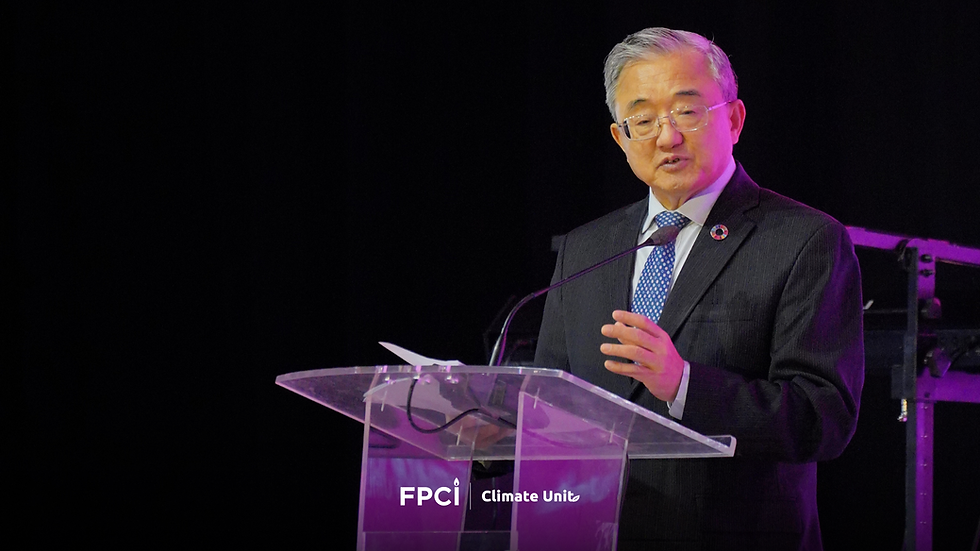
In his opening remarks, Ambassador Soemadi Brotodiningrat highlighted the increasing dangers of climate change, whose urgency is often overshadowed by other global issues like war and famine.
"When we talk about the environment and climate change, there are no borders between us. It will attack everyone indiscriminately," he emphasized. He stressed two crucial points: the importance of mutual cooperation and the empowerment of civil society to collectively assist governments in tackling this crisis.
Policy Analysis and Collaborative Roadmap
During the discussion, Qiu Jiahui addressed the Nationally Determined Contributions (NDCs) of ASEAN countries. She noted that while only Singapore and Cambodia have submitted updated NDCs, there is a promising trend of increasing ambition, particularly through sector-based targets. "The conditional targets in developing ASEAN countries are far more ambitious. This indicates a real need for international assistance and cooperation," she explained.
The discussion was enriched by interventions from the audience, who emphasized several critical points:
Priority for Indigenous Communities: Ensuring indigenous communities are central and primary beneficiaries of the climate transition.
Stronger Collaboration: Urging closer synergy among civil society organizations across ASEAN.
Intersectional Approach: Climate issues must be viewed through a lens connecting gender justice, disability rights, and other forms of equality.
This forum affirmed that ASEAN civil society is no longer merely a watchdog but has formed a new critical axis for climate action. Their role as innovators, community advocates, and strategic partners is acknowledged as the backbone of an inclusive green transition. Moving forward, borderless collaboration—among nations, sectors, and communities—is key to achieving climate security for all in Southeast Asia.
With this message, AFPC 2025 left a clear call: Time is up for fragmented action. Only through solidarity and just collective action can a net-zero ASEAN future be achieved.


Comments