
FPCI & IEEJ Convene the Indonesia–Japan Track 1.5 Dialogue on Transmission Cooperation

The Indonesia–Japan Track 1.5 Dialogue on Transmission Cooperation was held on Tuesday, 27 October 2026, at the Embassy of the Republic of Indonesia in Tokyo, Japan. Co-organised by the Foreign Policy Community of Indonesia (FPCI) and the Institute of Energy Economics, Japan (IEEJ), the dialogue brought together stakeholders from government, industry, finance, and research to explore how Indonesia and Japan can strengthen cooperation on electricity transmission infrastructure and support their respective energy transitions.

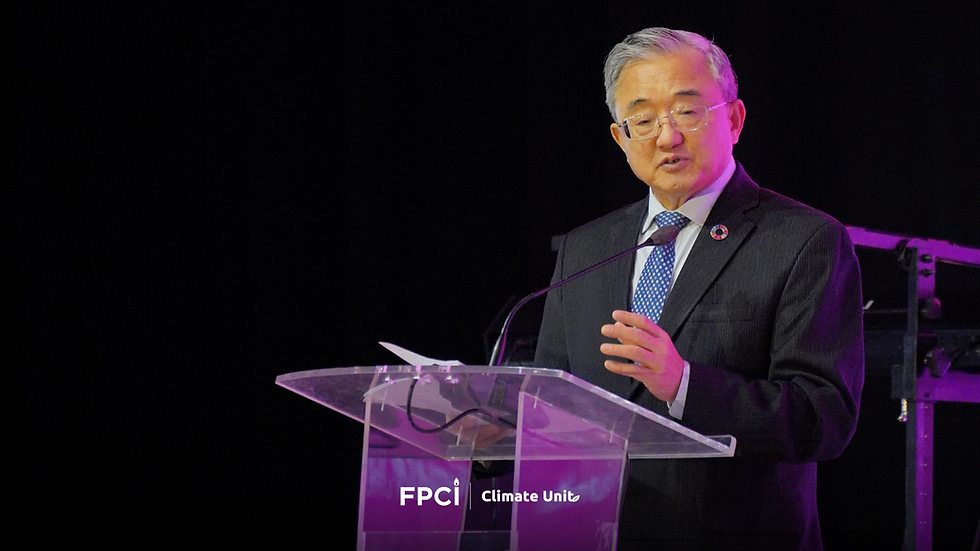
The dialogue was opened by Dr. Dino Patti Djalal, Founder and Chairman of FPCI; Dr. Nurmala Kartini Pandjaitan Sjahrir, Ambassador of the Republic of Indonesia to Japan and the Federated States of Micronesia; and Prof. Tatsuya Terazawa, Chairman and CEO of IEEJ.
In his remarks, Dr. Dino Patti Djalal underscored the strategic importance of transmission infrastructure to the bilateral partnership, stating: “Transmission is the infrastructure underneath the partnership. As two maritime middle powers, we do not need to wait for bigger powers to design this for us. We can build it ourselves.”
This perspective set the context for the dialogue, which was conducted as a closed-door, off-the-record discussion under the Chatham House Rule. Discussions centred on three themes: the current state of transmission development in Indonesia and Japan; financing approaches to support transmission infrastructure; and opportunities to advance bilateral cooperation through the Asia Zero Emission Community (AZEC).
Indonesia’s Energy Transition Depends on a Stronger Transmission Network
Indonesia’s energy transition requires transmission infrastructure to keep pace with renewable energy deployment and rising electricity demand. The first session examined both countries’ transmission plans, regulatory frameworks, and challenges in integrating renewable energy. Indonesia’s RUPTL 2025–2034 targets nearly 47,758 circuit-kilometres of new transmission lines and 69.5 GW of additional generation capacity. However, the discussion identified an implementation gap: without timely grid expansion, new generation capacity, particularly renewable energy located far from demand centres, cannot reliably deliver electricity to consumers.

Indonesia’s constraints are both geographical and structural. Its archipelagic geography, concentration of electricity demand in Java, and distance between renewable energy resources and major demand centres complicate grid planning and investment. Recent grid disruptions further exposed the need for greater system reliability and resilience. Japan faces a different set of constraints despite its more established electricity infrastructure. Expanding inter-regional transmission remains difficult, particularly in allocating costs among regional utilities and ensuring adequate returns on infrastructure investment. The discussion highlighted the role of long-term planning, coordinated investment, and regulatory mechanisms that distribute grid expansion costs and benefits across the power system.
From Transmission Development Plans to Bankable Projects
The RUPTL estimates USD 188 billion in power sector investment, including USD 24 billion for transmission lines. However, mobilising private investment remains difficult because transmission projects rely heavily on PLN’s balance sheet, placing construction, financing, and long-term ownership risks on the utility. With limited direct revenue from transmission assets, lenders require predictable payment structures, clear payment chains, and institutional continuity.

The dialogue examined several financing models, including an independent transmission company (ITC) and public-private partnerships (PPPs) based on availability payments. Under the ITC model, a private special purpose vehicle (SPV) would finance, build, and own transmission assets, while PLN and the Ministry of Energy and Mineral Resources retain responsibility for system control, planning, and tariff-setting. Enabling measures include recognising ITC payments within the electricity provision cost (Biaya Pokok Penyediaan [BPP]), extending the balance-sheet waiver granted to IPPs, designating grid expansion as a national strategic project (Proyek Strategis Nasional [PSN]), and introducing a dedicated transmission fee. Other options include transferring operational assets to investment trusts or securitising them to recycle capital, with a pilot project proposed to test their feasibility.

The proposed 2.6 GW Sumatra–Java HVDC interconnector, estimated to cost USD 4.8 billion, was identified as a potential pilot. Its viability depends on a workable availability-payment structure, government support for land acquisition and other project risks, and financing that accounts for the long construction period before revenue generation. Supply chain constraints, particularly the limited availability of HVDC converters, cables, and transformers, also require early planning, a credible project pipeline, and clarity on local content requirements. Indonesia–Japan cooperation could support the project through regulatory commitments, risk-mitigation instruments, Japanese development finance, and export credit. The dialogue emphasised that a successful pilot could establish a replicable financing model for future transmission projects and the ASEAN Power Grid.
Strengthening Indonesia–Japan Transmission Cooperation through AZEC

The dialogue examined how the Asia Zero Emission Community (AZEC) could turn its cooperation portfolio into bankable transmission projects. Despite leaders’ and ministerial meetings, numerous MoUs, and around 600 projects in its pipeline, only a limited number have reached financing. Transmission was seen as a prioritized element of energy security because renewable energy resources cannot strengthen domestic energy security without grid infrastructure to deliver electricity to demand centres. Participants also proposed broadening Japan’s POWERR Asia initiative, currently focused on emergency response and measures such as oil stockpiling, to include regional electricity transmission infrastructure.

Participants called for a phased approach, beginning with one or two domestic projects before advancing towards cross-border interconnections and the ASEAN Power Grid (APG). Timely commitments are essential as shortages of power transformers, constrained HVDC manufacturing capacity, and limited specialised engineering skills tighten global supply chains. To advance implementation, participants proposed a bilateral task force involving both governments, PLN, JBIC, JICA, parliamentarians, and independent experts, with a clear deadline to report to both countries’ ministers. Upcoming ASEAN and bilateral energy meetings could provide opportunities to secure political endorsement and advance the task force.

FPCI and IEEJ will continue to provide a platform for policy dialogue and stakeholder engagement on Indonesia–Japan energy cooperation, contributing to further exchanges on the practical challenges and opportunities involved in energy transition.


Comments