
How China is Building its Green Future and Lessons for the World
A dedicated session on China at the Indonesia Net Zero-Summit 2026 was organized to draw practical, first-hand lessons from its experience in rapidly scaling renewable energy and building competitive green industries. The session was anchored around China’s 15th Five-Year Plan, sought to unpack the key drivers behind China’s transition and explore how these experiences could inform other countries seeking to accelerate their energy transition while building a competitive and resilient green industrial base.
Urging Stronger Cooperation amid a Changing Global Landscape
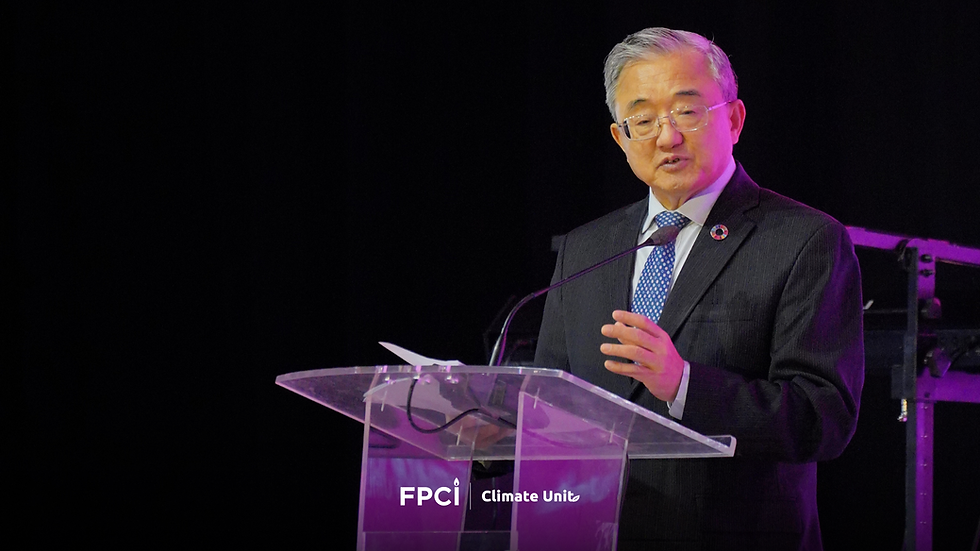
The discussion opened with a scene-setting address by H.E. Liu Zhenmin, Special Envoy for Climate Change of the People’s Republic of China, who placed China’s energy transition within a broader geopolitical context. He highlighted how rising geopolitical rivalry, unilateralism, and fragmentation in global supply chains are making the transition more difficult and costly, particularly for developing countries. “Unilateralism and green barriers have driven up the cost of energy transition, while supply chain derisking has hindered international collaboration,” Special Envoy Liu said.
These challenges are significant for developing countries which are navigating climate action alongside other pressing economic issues. At the same time, Special Envoy Liu argued that the global transition continues to gather momentum with renewable energy increasingly becoming a market-driven opportunity rather than a purely policy-driven agenda. The sharp decline in renewable energy costs over the past decade, he noted, has also reinforced the role of clean energy in strengthening energy security.
Against this backdrop, he called for stronger multilateral cooperation, technological innovation, and greater support for developing countries. “Finance and technological innovation are the source and driving force for global energy transition,” he stressed.
Policy Direction and Domestic Determinants of China’s Transition Journey

The discussion then turned to China’s domestic experience and the policy choices that have enabled its rapid expansion of renewable energy and clean technology industries.
Prof. Zheng Li, Vice President of Institute of Climate Change and Sustainable Development (ICCSD), Tsinghua University, outlined a clear sequence behind China’s transformation: “first, setting long-term targets; then, rolling out sustained industrial incentives; then, scaling up manufacturing to drive global cost declines.”
This approach was reinforced by a long-term policy architecture that provides businesses and investors with greater clarity over the direction of China’s energy system. China’s 15th Five-Year Plan sets clear targets, including raising the share of non-fossil energy in primary energy consumption to 25% and increasing the combined share of wind and solar to more than 50% of installed power capacity, which provide concrete indicators of where the country is heading. These national objectives are then translated through implementation mechanisms at the provincial and local levels.
The combination of long-term policy direction and sustained industrial support has also produced tangible results. Prof. Zheng Li noted that China drove down solar PV costs by roughly 80% through mass production and iterative research and development, transforming the country from a net importer of clean technologies into one of the world’s leading producers.

But policy direction alone is not enough as the institutional architecture also needs to allow businesses to respond to those signals. Dr. Ting Li, Managing Director and Chief Representative of RMI China, pointed to China’s recent introduction of the “Green Power Link” as one example. Previously, companies seeking to purchase green electricity directly from a supplier faced a system in which electricity had to pass through the state grid. The new policy opens greater space for direct transactions, allowing companies to source green electricity from suppliers based on factors such as proximity and cost. The broader lesson is that accelerating the transition requires not only ambitious targets, but also removing institutional barriers that prevent the market from acting on them.
For investors, this predictability and flexibility is critical. China has sought to create confidence that the market itself will continue moving in a particular direction rather than relying solely on financial incentives. As Prof. Zheng Li put it, “I want to highlight the physical, non-negotiable signals that de-risk investment.”
One important lesson for countries seeking to accelerate their own transition is that ambitious targets need to be accompanied by credible implementation mechanisms, market-enabling rules, and policy signals that give businesses and investors confidence that the direction of travel will be sustained.
Scaling Renewables, Building Low-Carbon Industry

For Indonesia and China, several areas of cooperation are becoming increasingly relevant as both countries pursue their respective energy and industrial transitions. The discussion highlighted large-scale renewable deployment and low-carbon industrial development as two areas where existing capabilities and priorities could be brought together.
Indonesia’s 100 GW solar ambition provides one immediate area for cooperation. Special Envoy Liu Zhenmin noted China’s willingness to support the programme, saying, “My government actively encourages Chinese companies to join hands with Indonesia partners to deliver this program.”
But scaling solar is not only about adding generation capacity. Riyadi Suparno, Executive Director of Tenggara Strategics highlighted the need to consider the broader electricity system and emerging sources of demand, including the rapid growth of data centres. Expanding renewables will therefore require parallel investment in transmission, grid flexibility, and system integration.
This points to a broader cooperation agenda spanning investment, technology, infrastructure, and system integration, where China’s experience in scaling renewable manufacturing and deployment can meet Indonesia’s growing energy needs and market opportunities.
A second area is low-carbon industrial development. China’s initiative to develop 100 net-zero industrial parks by 2030 offers a relevant reference as Indonesia expands its own industrial parks and downstream industries.

Dr. Ting Li emphasised that the priority is translating such ambitions into projects and business models that work on the ground, requiring “strong partnership” and coordination across stakeholders. For Indonesia, low-carbon industrial parks could bring together renewable energy, industrial efficiency, technology, investment, and green value chains, while creating opportunities to strengthen local capabilities through technical exchanges, skills development, and greater participation of Indonesian businesses.
China has Shown what is Possible. Can its Lessons Be Adapted?

China’s experience ultimately raises a broader question: can other countries replicate the conditions that enabled its green transformation? The answer is unlikely to be a simple yes or no. China’s scale, institutions, industrial base, and policy system are distinct, but the underlying lessons are more transferable: set clear long-term direction, create the conditions for investment, build domestic industrial capacity, remove institutional barriers, and ensure that projects deliver both environmental and economic value.
For countries pursuing their own transitions, the task is therefore not to copy China’s model wholesale, but to identify which elements can be adapted to their own circumstances. The value of China’s experience lies precisely in demonstrating what can be achieved when policy, industry, technology, and implementation move in the same direction.
As Special Envoy Liu Zhenmin concluded, “The journey ahead is long, but the future is promising.”


Comments