
It's Time to Deliver: Turning Indonesia's Climate Ambition into Action

Over the past several years, Indonesia has made increasingly ambitious climate and energy transition commitments, backed by stronger political signals at the highest level, such as the 100 GW solar program. With impacts of the climate crisis intensifying across the board, and the window for action narrowing, this year’s Indonesia Net-Zero Summit (INZS) strikes a unified call to turn ambition into implementation and commitments into results.
On Saturday, 1 August 2026, INZS returned for its fifth edition at Balai Kartini, Jakarta, bringing together government officials, diplomatic community, private sectors, academia, youth and civil society with the theme “It’s Time to Deliver!”.
The Climate Crisis Does Not Wait

In his opening remarks, Dr. Dino Patti Djalal, Founder and Chairman of FPCI, argued that climate change has outgrown its old box, and that it does not wait for us to respond properly.
“Climate is the superstructure that determines your health, politics, peace, security, economy, industry, migration, individual and social well-being, infrastructure, food, energy, water, jobs—everything—and it is the most important force which determines the fate of humanity. [...] If we don’t get the climate right, we get everything else wrong.” — Dr. Dino Patti Djalal, Founder and Chairman of FPCI
As a developing country, Indonesia must continue to grow its economy and improve living standards while simultaneously responding to a rapidly worsening climate. But with only a limited time window to avoid the most severe and irreversible impacts of climate change, inaction itself is a risk. The answer, Dr. Dino argued, is not to wait for the geopolitical landscape to stabilize. The climate crisis will not wait for the world to settle down, and neither can Indonesia’s response.
In a Fragmented World, Cooperation is the Key
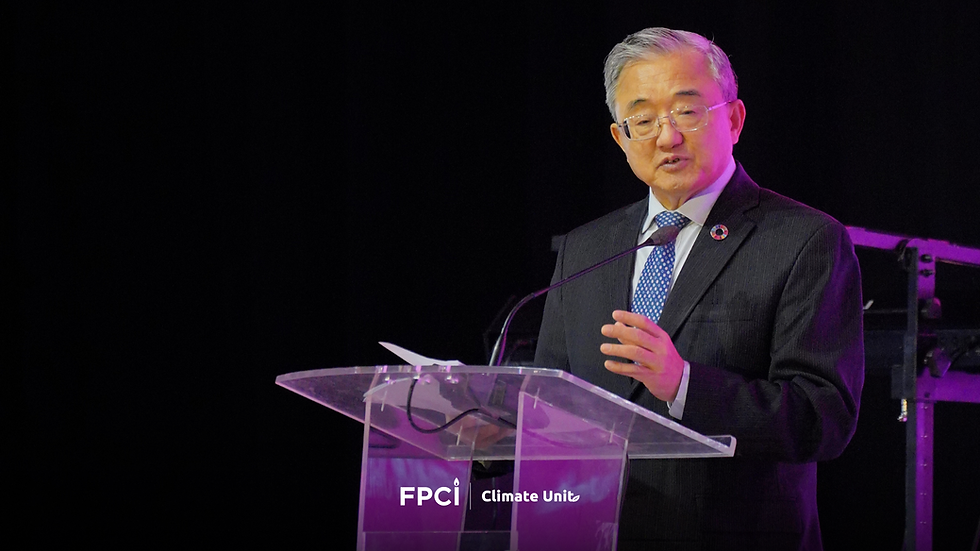
In her special remarks, United Nations Secretary-General's Special Envoy on Water Retno Marsudi brought an often-overlooked dimension of the net-zero transition to the forefront: water. While discussions on net-zero frequently center on energy, transport, and industry, Retno reminded the audience that water underpins both mitigation and adaptation.

“Water and net-zero are inherently intertwined. Water is the foundation of net-zero transition and there is no net-zero without water security. Water enables mitigation. Water enables adaptation, and water ecosystems are climate solutions.” — Retno Marsudi, United Nations Secretary-General's Special Envoy on Water
Countries may disagree on politics, trade, and security, but they remain connected by shared vulnerabilities to water scarcity, food insecurity, disasters, and other climate impacts. Retno therefore called for two things: faster implementation, and stronger partnerships across countries and sectors. Geopolitics should not become a reason to stand still or retreat from cooperation. While Indonesia cannot control the direction of global politics, it can determine how strategically it uses its diplomatic relationships and international partnerships to advance its interests.
Delivery Must Be Just, Not Merely Fast
A successful net-zero transition must be measured by both its speed and whether it creates better opportunities and tangible benefits for the people and communities, especially those whose livelihoods are closely tied to the natural resources and the existing economy. In his keynote speech, Minister of Environment / Head of the Environmental Control Agency of Indonesia Moh Jumhur Hidayat called for prosperity to become a third pillar of Indonesia’s climate action, alongside mitigation and adaptation.

“Around the world, we generally recognize two types of climate action: mitigation and adaptation. But I believe Indonesia should add a third pillar: prosperity. Because if we speak only about mitigation and adaptation, it will ultimately be local communities—the people on the ground who are actually protecting our environment—who bear the greatest burden. That is why they must also receive the greatest share of the benefits — Moh Jumhur Hidayat, Minister of Environment / Head of the Environmental Control Agency of Indonesia
Minister Jumhur argued that the benefits of climate action must reach communities on the ground. Carbon market revenues, for example, should create lasting economic opportunities, with cooperatives and MSMEs helping to ensure that benefits are reinvested in communities and generate self-propelling growth. Prosperity should be part of Indonesia’s climate action.
From Geopolitical Shifts to Domestic Delivery
The opening session, “The Next Chapter of Indonesia's Climate Agenda: Rising to the Challenges of a Fragmented World”, brought the implementation conversation to a more practical level in the midst of a fragmented geopolitical landscape. Featuring Vice Minister of Environment of Indonesia Diaz Hendropriyono, Director of Economic and Environmental Development at the Ministry of Foreign Affairs of Indonesia Tri Purnajaya, and Director of Climate Policy Initiative Indonesia Tiza Mafira, the discussion examined how Indonesia is navigating geopolitical and energy landscape shifts while advancing its climate and energy interests, accelerate necessary reforms and investment, strengthen energy security and resilience, and capturing economic opportunities of the transition.
One central message from Vice Minister Diaz was that Indonesia cannot control geopolitical tensions unfolding beyond its borders, nor fully shield itself from their spillover effects. The imperative, therefore, is to prepare and strengthen Indonesia’s capacity to respond and manage the impacts.
Tiza Mafira illustrated what this can mean in practice through a comparison between Pakistan and Bangladesh. As fossil fuel prices rose, Pakistan accelerated household solar deployment through subsidies and grid connections, becoming a leading example of a solar boom and reportedly saving USD 6.5 billion in energy expenditure. Bangladesh, facing similar renewable energy potential and similar external price pressures, did not make a comparable shift and instead saw its energy spending double. This comparison shows that external shocks can either deepen vulnerability or accelerate domestic transformation.
With Indonesia spending more than IDR 200 trillion on energy subsidies, and every USD 1 increase in energy prices adding around IDR 6 trillion to the subsidy burden, accelerating Indonesia's renewable energy deployment is important for its economic resilience, energy security, and household welfare.
The discussion then turned to how Indonesia can translate its commitments into delivery. Vice Minister Diaz emphasized the need to use multilateral agreements and international platforms to lock in commitments and expand access to climate finance, while also identifying underutilized domestic funding sources. Indonesia’s estimated climate financing needs of around IDR 470 trillion annually through 2030, against roughly IDR 76 trillion currently available, makes closing this gap central to implementation. Director Tri similarly stressed that Indonesia’s engagement in platforms including the UNFCCC, G20, BRICS, and the OECD accession process should be treated as political investments that can be converted into economic and social gains.
For Tiza, the remaining window for action is narrow. The priority is to turn Indonesia’s existing ambitions into outcomes that people can see and feel, while making the country more competitive in attracting green investment. That means reducing barriers to investment, strengthening domestic skills, and ensuring that the energy transition creates jobs and tangible economic benefits. Director Tri Purnajaya echoed the need to move from political achievements to implementation, while Vice Minister Diaz emphasized closing delivery gaps and ensuring that the transition generates green jobs and broader prosperity.
Five Priorities to Turn Ambition into Action
Dr. Dino outlined five priorities for turning Indonesia’s climate ambitions into tangible progress:
Deliver President Prabowo’s 100 GW solar programme;
protect Indonesia’s forests, peatlands, mangroves, and other natural carbon sinks;
develop a robust Indonesian carbon market;
strengthen Indonesia’s climate diplomacy; and
deepen cooperation between government and civil society.
The 100 GW solar program, in particular, offers an opportunity to demonstrate that Indonesia can move from targets to implementation at scale. Bringing it to life could strengthen energy resilience while sending a powerful and credible signal to investors that Indonesia is serious about its energy transition. The Government’s political commitment is clear; the next step is to secure it with a solid regulatory foundation that can carry the program from political commitment to sustained implementation.
Protecting Indonesia’s forests and natural carbon sinks is equally critical. As Dr. Dino warned, emission reductions achieved in energy, industry, and transport could be undermined if deforestation continues. Indonesia cannot build its transition on one side while eroding its natural carbon sinks on the other.
Alongside these priorities, Indonesia must also make better use of the platforms it already has. A stronger carbon market can help mobilise climate finance, while Indonesia’s position in multilateral and minilateral forums gives it opportunities to push for more progressive international climate action. At home, closer cooperation between government and civil society can help strengthen accountability, ideas, and implementation.
It’s Time to Deliver!
As Edi Prio Pambudi, Deputy for Economic Cooperation and Investment at the Coordinating Ministry for Economic Affairs of the Republic of Indonesia, mentioned in his keynote address, “It’s Time to Deliver” is not merely a slogan, but a call to get the work done.

Indonesia cannot afford to wait for a less fragmented world, nor should it treat climate action as a choice between prosperity and sustainability. The transition must make Indonesia more resilient, more competitive, and more prosperous while ensuring that its benefits reach people and communities across the country.


Comments