
Key Reflections from FPCI's ASEAN Community Building Forum in Cebu on Energy Security and Climate Resilience in Southeast Asia

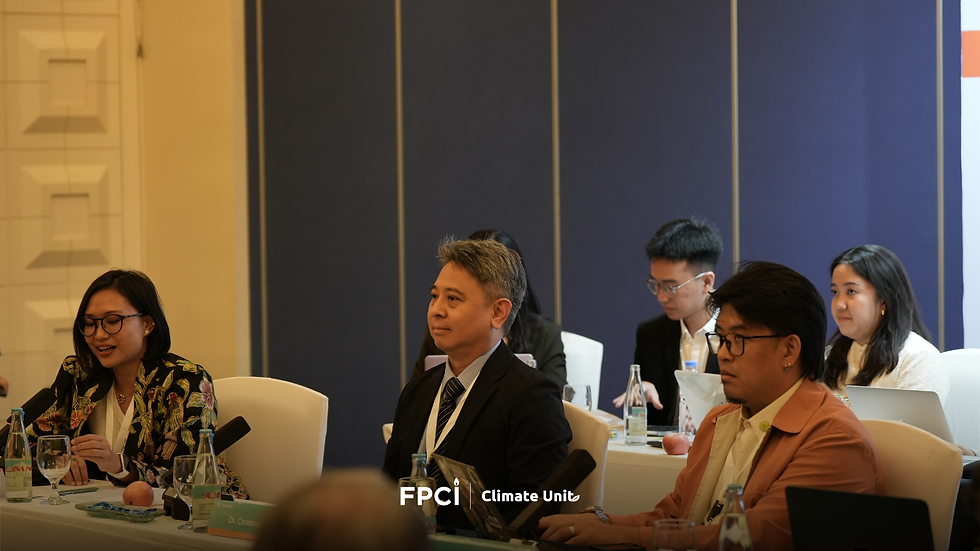
The Foreign Policy Community of Indonesia (FPCI) convened the ASEAN for the Peoples’ Week (AFPW) in Cebu, Philippines, alongside the ASEAN Summit 2026. As part of the week’s agenda, FPCI hosted the ASEAN Community Building Forum on Thursday, 7 May 2026. The dialogue brought together official and non-official representatives from across Southeast Asia, including policymakers, experts, civil society leaders, academics, and practitioners, to exchange perspectives on some of the region’s most pressing challenges.
One of the key sessions, titled “Powering a Resilient ASEAN: Energy and Climate Security in a Changing World,” examined how ASEAN can strengthen its energy security and climat#e resilience amid growing geopolitical uncertainty.

Participants reflected on how recent geopolitical tensions and supply disruptions have exposed the structural vulnerabilities of ASEAN’s energy system. These disruptions have contributed to rising energy costs, food insecurity, and broader economic pressures across the region, reinforcing the need to build more resilient, diversified, and domestically anchored energy systems.
Rethinking ASEAN’s energy model

The discussion underscored that long-term energy resilience will depend on accelerating domestic renewable energy deployment, expanding energy storage, modernizing electricity grids, and strengthening regional power interconnections.
ASEAN is well-positioned to advance this transition, given its abundant renewable energy resources and regional commitments under APAEC 2026–2030 to increase renewables to 30% of total primary energy supply and 45% of installed capacity. Realizing these ambitions, however, will require market reforms that better integrate distributed energy resources, improve system flexibility, and create a more predictable and investable regulatory environment.
While ASEAN has adopted strong regional commitments and policy declarations on energy transition and climate cooperation, implementation remains uneven across member states due to differences in institutional capacity, regulatory readiness, financing conditions, and technical capability. Closing these implementation gaps will require stronger institutional capacity, closer stakeholder coordination, and regional cooperation mechanisms that can translate commitments into scalable action.
ASEAN can still shape its climate ambition through stronger regional cooperation

The discussion also highlighted several existing models of cooperation that could inform broader regional efforts. The Lao PDR–Thailand–Malaysia–Singapore Power Integration Project (LTMS-PIP), for example, has demonstrated the technical feasibility of cross-border electricity trade by transmitting hydropower from Lao PDR to Singapore. Such initiatives show that ASEAN can advance energy transition in a way that strengthens regional integration while keeping people at the center of development.
Examples from across the region also showed how energy transition is increasingly being framed through a people-centered lens. In the Philippines, for instance, the shift toward renewable energy is being linked to inclusive, reliable, affordable, and clean power as a foundation for economic development and green industrial growth. Recent energy disruptions have further reinforced the need to accelerate deployment, including through local government efforts to solarize public buildings and redirect savings toward social services.
The importance of diversifying regional partnerships

Participants also stressed that ASEAN must diversify financing sources and improve project bankability to avoid overdependence on any single external funder. At the same time, deeper ASEAN market integration can strengthen regional bargaining power, increase flexibility, and improve long-term resilience. A larger and more integrated regional market would also give ASEAN more room to attract investment, widen the pool of partners, and shape the transition on its own terms.
ASEAN must advance the transition through skills development and public support

Another recurring theme was the need for workforce reskilling and upskilling, particularly for workers transitioning from industries that have existed for decades, such as coal, oil, and gas into emerging sectors like renewable energy, clean technology, and green industries.
The discussion also highlighted the importance of more inclusive frameworks that bring youth, women, and underrepresented groups into transition planning, while strengthening social protections for vulnerable communities.
Expanding equitable energy access remains essential, especially through technologies and business models that can address last-mile and high-cost connections. Participants also pointed to the need for earlier education pathways and clearer mapping of future workforce needs to close emerging talent and capacity gaps across clean energy industries.

Ultimately, the dialogue made clear that turning ambition into implementation will depend on stronger investment in human capacity, more effective peer learning, streamlined permitting systems, more integrated regional markets, and a more diversified flow of investment.
ASEAN’s energy transition, participants agreed, will succeed only if it is built not just on policy ambition, but on practical cooperation, institutional readiness, and people-centered implementation.


Comments