
Voices from Cebu: FPCI ASEAN Community Town Hall Calls for Greater Regional Cooperation on Climate and Energy Security
Updated: Jun 26
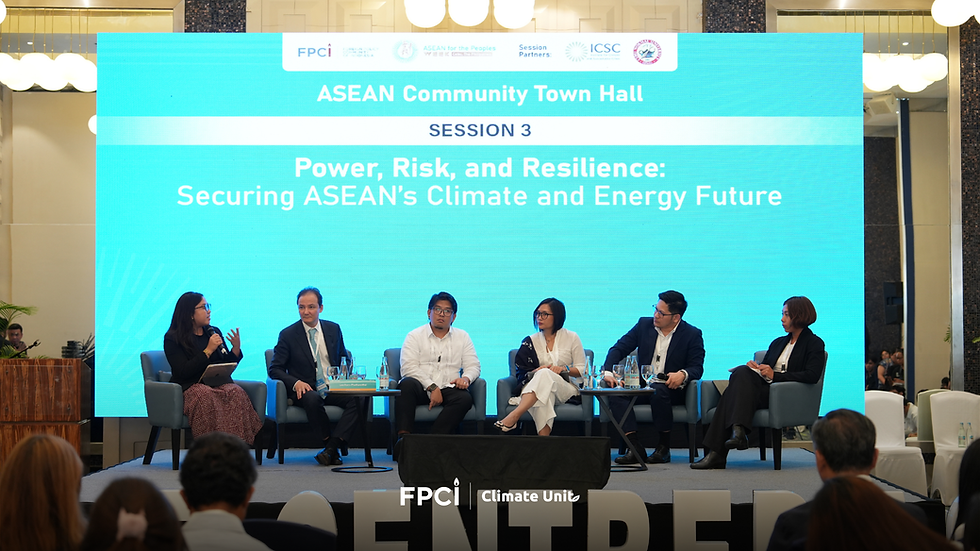
As part of the ASEAN for the Peoples Week held in Cebu, Philippines, the Foreign Policy Community of Indonesia (FPCI) convened the ASEAN Community Town Hall on May 8, 2026. The session, titled "Power, Risk, and Resilience: Securing ASEAN's Climate and Energy Future," brought together experts and civil society leaders to discuss how the region can build a more secure, sustainable, and inclusive energy system.
The session was moderated by Kiara Putri Mulia (Foreign Policy Community of Indonesia) and featured speakers Angelo Kairos dela Cruz (Institute for Climate and Sustainable Cities), Leo Horn-Phathanothai (Just Transitions Incubator), Tiza Mafira (Climate Policy
Initiative Indonesia), Rexer Amancio (Global Renewables Alliance Asia-Pacific), and Sokphalkoun Out (EnergyLab Asia), with Dr. Janet Mananay of Cebu Normal University as discussant.
The Strait of Hormuz Crisis as a Wake-Up Call for the Region

Nearly 80% of ASEAN's energy still comes from fossil fuels, and over two-thirds of the region's oil and gas trade passes through conflict-vulnerable chokepoints. The recent Strait of Hormuz crisis brought that exposure into sharp relief, as fuel prices climbed across Southeast Asia in response to disruptions far beyond the region's control.
Leo Horn-Phathanothai, Founder and Executive Director of the Just Transitions Incubator (JUTI), pointed to countries that had already been investing in home-grown renewables as a reference point. India, for instance, saw growth in solar capacity outpace the disruption to its fossil fuel economy. Most ASEAN countries, by contrast, remain in a position of structural dependency that leaves them acutely vulnerable to the kind of supply shock the crisis produced.
"What this crisis is showing us is that this energy transition is much bigger than an energy issue," Horn-Phathanothai said. "It's about: what kind of future do we want? What kind of development choices do we want to make? Do we want to be dependent on a source of fuel that is beyond our control, when we have the option to create cheaper, safer, more affordable energy right at home?"
The crisis, in his view, has done what years of climate advocacy could not: it reframed energy security as a mainstream political concern, prompting countries like Indonesia and Thailand to accelerate renewable energy commitments not out of environmental pressure, but out of economic and strategic necessity.
Finance is Available, but Demand Needs to be Stronger

One of the most pointed contributions of the session came from Tiza Mafira, Director of Climate Policy Initiative (CPI) Indonesia, who challenged the common assumption that financing is the primary obstacle to energy transition in Southeast Asia.
Fifty percent of global climate finance already flows into Southeast Asia, she noted. In 2023 alone, those flows grew 70% year-on-year from both public and private sources, a trend that has continued even as some governments pulled back on climate commitments and major banks revised their net-zero pledges. Private investors, she argued, are still putting money into clean energy because it is profitable and less volatile than fossil fuels, whose prices are driven by geopolitics rather than market fundamentals.
"Finance needs to increase and finance needs to find its home in our home in Southeast Asia," Mafira said. "Nothing accelerates finance more than demand for it. So this region needs to really consistently show demand for that finance."
She identified three areas where that demand needs to be most visible: renewable energy deployment, transmission infrastructure, and fossil fuel retirement. On the last point, she was direct about the Indonesian context. While coal is domestically abundant, its prices are as volatile as oil and gas, meaning domestic sourcing does not insulate the country from market shocks. A clear signal that fossil fuel assets will be retired, she argued, is also what prevents the region from accumulating stranded assets down the line.
Rexor Amancio, Regional Lead for Asia-Pacific at the Global Renewables Alliance, added that creating the right enabling environment for private investment is as important as the investment itself. Grid modernization, auction processes, and permitting frameworks all determine whether capital can actually be deployed at scale. Right now, many of those frameworks remain underdeveloped or inconsistent across the region.
Infrastructure and Skills Remain Significant Gaps

Beyond financing, the panel highlighted two structural gaps that receive less attention but are just as important: transmission infrastructure and human capital.
On infrastructure, Mafira stressed the importance of the ASEAN Power Grid project, which would interconnect member states and allow the region to draw flexibly from multiple renewable energy sources. A modernized, smart grid doesn't just move electricity, it gives the region flexibility in where power comes from, which in turn makes the overall system more reliable and resilient to supply disruptions.
On human capital, Out offered a direct assessment of where Cambodia stands. The country has renewable energy targets on paper, but the workforce needed to deliver on those targets—engineers, technicians, policy officers, finance professionals with clean energy expertise—is far from ready. "If you look at the human side, I think that we haven't built enough yet in terms of human capital and infrastructure," she said.
EnergyLab Asia has been running skills development programs in Cambodia and Laos aimed at young professionals in finance and banking, helping them understand and work within the clean energy sector. Out framed this as one of the clearest low-hanging fruits available: the transition requires people from every sector who understand how clean energy investment works.
Dela Cruz echoed this point, noting that part of what the transition demands is a generation of professionals who can bridge technical knowledge with policy, community engagement, and finance, and that ASEAN, particularly under the current Philippine chairship, has an opportunity to build that pipeline collaboratively across member states.
What "People-Oriented" Actually Means

A recurring theme across the session was the need to move energy discussions out of purely technical circles and into broader public and policy conversations. Angelo Kairos dela Cruz, Executive Director of the Institute for Climate and Sustainable Cities (ICSC), argued that energy policy has for too long been treated as the domain of engineers and developers, when in reality it touches every aspect of people's daily lives.
"We are at a juncture wherein we can proudly say we have the opportunity to no longer discuss ASEAN in a vacuum, in a silo," dela Cruz said. "We don't have to discuss energy as if energy is just for technical people, engineers and RE developers. The framing that everything we do should first matter to the people on the ground."
Sokphalkoun Out, Energy Policy Manager at EnergyLab Asia, reinforced this point from a sectoral perspective. Energy, she noted, is not a standalone issue. Agriculture, telecommunications, transport, and virtually every other sector of the economy depends on it. The panel broadly agreed that policies and programs should reflect what communities actually need, rather than what looks good in regional frameworks. As Out put it, "Cambodia's needs might be different from what the Philippines needs, might be different from what Indonesians need. So I guess we'll come together as unity, but also recognize that different countries need different needs and need different voices to shape that change."
That people-first framing extends to how transition projects interact with local communities on the ground. Mafira argued that renewable energy technology, unlike fossil fuel infrastructure, allows for genuine flexibility in scale. Community-based solar installations, which are small enough to power a village or a cooperative farm, large enough to generate revenue, are already operating in parts of the region. Indonesia's recent 100-gigawatt cooperative-based solar target is one example. "This is the first time that we can actually say: we don't need big corporations to come in and own these power plants. We can own it ourselves and enjoy the revenue by ourselves," she said.
Building a Unified Regional Voice

Much of the session's discussion circled back to a broader question: what does ASEAN actually want, and does it say so clearly enough? Horn-Phathanothai cautioned against letting the current moment of crisis collapse into a scramble to restore what existed before. “Whereas the opportunity of this moment, the invitation of this moment, is for us to double down, to seize this once-in-a-generation opportunity to find a path forward to the greener future," he said.
Seizing that opportunity, speakers agreed, requires ASEAN to function less like a collection of individual states and more like a region with a shared vision. "The promise of ASEAN is building an economy—an electro-economy—based on solidarity across the region. That we bring our assets together, we bring our dreams together, and we build a regional electro-economy that can withstand the kinds of shocks that we saw with the Strait of Hormuz."
ASEAN is simultaneously one of the world's most climate-vulnerable areas and the region driving the fastest growth in emissions, a combination that gives it both a deep stake in global climate outcomes and real leverage to shape them. Yet that leverage remains largely untapped. As Horn-Phathanothai put it, "We are a region that needs to be taken seriously. Yet we don't show up as a region. We don't show up at climate negotiations and at the COPs as one. We show up as disparate voices wanting different things."
"There is going to be tremendous power unlocked if we were to come together," he added. "Unity is our strength, and it will be an incredible strength for this region if we could do this."
Dela Cruz pointed to the upcoming Conference of Parties in Turkey as a near-term test of whether that unity is achievable. "I think it's going to be crucial and I'm really hopeful that ASEAN would have a better showing as a region when it comes to the climate negotiations," he said.
The session also pointed to existing frameworks, such as the ASEAN Plan of Action for Energy Cooperation (APAEC), as a foundation to build on. Out noted that APAEC already provides a guiding structure for member states to cooperate on energy connectivity, security, and sustainable transition. The challenge, as with so much in the region, is translating those commitments into consistent implementation at the national and local level.
The ASEAN Community Town Hall affirmed that the region has the resources, the frameworks, and the growing political will to advance a meaningful energy transition. What it requires now is stronger coordination, a more unified voice at the global level, and policy that is genuinely grounded in the needs of the people it is meant to serve.

The audience at The ASEAN Community Town Hall organized by the Foreign Policy Community of Indonesia (FPCI) as part of ASEAN for the Peoples Week, held in Cebu, Philippines on May 8, 2026.
The ASEAN Community Town Hall was organized by the Foreign Policy Community of Indonesia (FPCI) as part of ASEAN for the Peoples Week, held in Cebu, Philippines on May 8, 2026.


Comments